
The hidden costs of reactive maintenance
Published on 07.07.2026
WAKU Care
WE EMPOWER UPTIME HEROES
Your Software Platform that keeps machines running.
Kicking off our article series 'From Signal to Solution: Predictive Maintenance & Closed-Loop Maintenance'
The Hidden Costs of Reactive Maintenance and Why Predictive Maintenance Is No Longer a Luxury
It is 3:14 AM. A system is down. The technician on site does not know why. The error message in the system says little. The colleagues who know the machine are unreachable. Production is at a standstill. Every minute costs money.
This scenario is not the exception. It is the daily reality for thousands of maintenance teams around the world. And it is the result of a decision many companies never consciously made: the decision to rely on reactive maintenance.
Reactive maintenance is not a law of nature. It is an expensive habit.
What Unplanned Downtime Actually Costs
The numbers are clear. According to the Siemens True Cost of Downtime Report 2024, Fortune Global 500 companies lose $1.4 trillion annually to unplanned downtime — equivalent to 11 percent of their total revenues. The average large manufacturing operation loses around $260,000 per hour when a critical line goes down. In automotive manufacturing, that figure rises to $2.3 million per hour.
Two thirds of surveyed production facilities report unplanned downtime occurring at least once per month. And the visible costs are often just the tip of the iceberg: quality losses, contractual penalties, reputational damage, and the effort required to recover lost capacity multiply the real costs by a factor of two to three.
But even these figures fail to capture the full pain. They do not show the cost of a skilled technician spending hours searching through paper logs to understand the context of a fault. They do not reflect the downstream costs when spare parts are unavailable because nobody saw the failure coming. And they do not show what it costs a company when critical knowledge lives in the head of one employee who is on leave.
According to industry data, reactive maintenance costs up to 4.8 times more than the same intervention when planned and prepared in advance.
Why Reactive Maintenance Persists Despite the Evidence
If the costs are this clear, why do so many companies not change?
The honest answer is complex. Part of the problem is a lack of visibility. Failures are logged, but rarely analyzed. Fault patterns stay invisible because the data is scattered across too many systems: machine controllers, spreadsheets, paper records, email threads. Nobody sees the full picture.
At the same time, the perceived complexity discourages action. Predictive maintenance has long been seen as the domain of large corporations with dedicated data science teams, months-long IT projects, and seven-figure budgets. A 2024 VDMA study shows that more than 60 percent of German SMEs consider intelligent maintenance one of the most important levers for digitalization. But there is a significant gap between conviction and action.
According to industry analyses, 60 to 70 percent of predictive maintenance initiatives fail not because of the technology, but due to missing expertise, poor data quality, and inadequate change management. The barrier is real. But it is solvable.
Why Now Is the Right Moment
The predictive maintenance market is growing fast. Analysts estimate the global market volume at over $14 billion in 2025, with an annual growth rate exceeding 26 percent. Pressure from regulation, competition, and rising energy costs makes predictive maintenance not just sensible — but necessary.
At the same time, something decisive has changed: the barrier to entry has fallen.
Modern solutions do not require months of IT integration. They do not need data scientists to train AI models. They build on data that already exists. And they deliver results in weeks, not years.
What companies need today is not another reporting tool that collects data and displays it in dashboards. What they need is a platform that turns signals into actionable recommendations. One that does not just show an error code, but places it in context. One that does not leave a technician alone with raw data, but helps them understand what to do next.
The difference between reactive and predictive maintenance is no longer a technical difference. It is a strategic one.
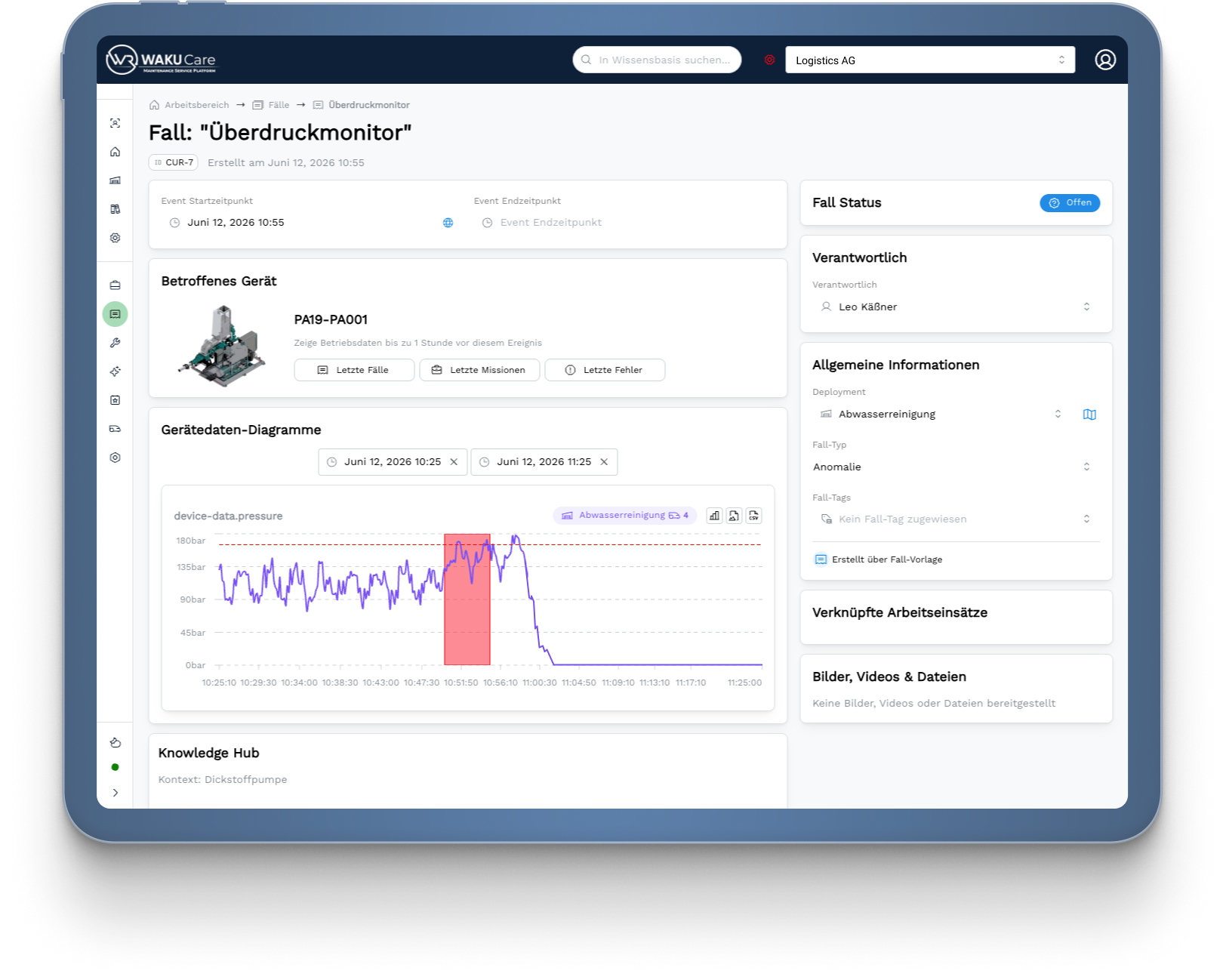
From Signal to Solution
This article series shows how maintenance teams in robotics and automation environments can make the shift from reactive to predictive maintenance — without months-long IT projects and without interrupting operations.
WAKU Care was not developed in a lab. The features of this platform are the result of direct collaboration with teams who know this pain firsthand: technicians standing in front of a stopped machine at three in the morning. Managers reviewing failure logs, searching for patterns that cannot be found because the data does not connect.
In the upcoming articles of this series, we explain in concrete terms which mechanisms enable predictive maintenance in practice, how teams can get started, and what Closed-Loop Maintenance means.
If you are curious about what getting started with predictive maintenance looks like without a major IT project, you can request a demo directly.
Next Articles in the Series
Article 02 — Recognizing Patterns Before Something Breaks — the Timeline View in the Asset Record File
Article 03 — From Data Point to Ticket in Seconds — Marking Anomalies Directly in the Operational Data Charts (link coming soon)
Article 04 — Closed-Loop Maintenance — From Sensor Signal to Solution Proposal Without Manual Intervention (link coming soon)
Article 05 — AI That Thinks Like an Experienced Technician — IMA as a Smart Assistant in the Closed Loop (link coming soon)
Article 06 — Predictive Maintenance in 30 Days — How Teams Get Started with WAKU Care Without a Major IT Project (link coming soon)
WAKU Robotics supports you in choosing the right robot for your application. We take care of the procurement of the robots as well as the on-site test. Our WAKU Care software helps you to operate the robots across manufacturers and to analyze the processes.
Contact WAKU